
Alternative investments are no longer limited to institutional investors. As private market products become more accessible, understanding their role in a portfolio, the potential diversification they may provide, and the importance of careful manager selection has become increasingly important.
Read the full transcript
AJ, we are seeing a lot of advisors putting their clients in so-called alts, or alternative private market products. And even 401(k) plans are now gaining access to them. Is it safe to say they aren’t private anymore?
Yeah, it’s a good question. I definitely think it’s safe to say that they’re not. They’re not necessarily as private as they used to be. I mean, it used to be a case where, if you were going to invest in private equity or hedge funds, off-market real estate, infrastructure, really that’s something that you could only do if you were an institutional investor with 50 or 100 million under management and an infinite time horizon. Today, if you have 2,500 or 5,000, there’s probably some form of a private market fund that you can have access to .
With that, I think it’s safe to say that there’s probably too many funds out there, and I think, between the three of us, we probably get an email every day from a new private credit manager asking us for business.
But you have to understand why these products are being offered in the first place. As an example, in 2022, stocks got killed, and the hope is that bonds come to the rescue.
They didn’t. And so I think, when you’re looking at some of these private markets assets, if there’s an element of diversification or shock absorbent to what your traditional stock and bond portfolio is doing, that’s attractive. So again, whether it’s direct lending, real estate, private equity, some hedge funds, or infrastructure, if there’s a diversification component, I think that’s compelling.
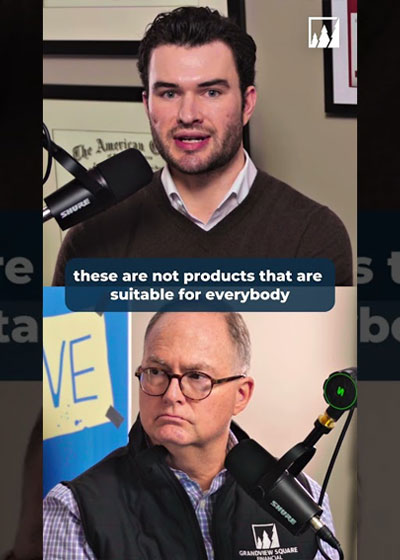
But these are not products that are suitable for everybody. I mean, the fee structures can be complex. Tax reporting is different. Liquidity profiles are different.
I was just looking at a chart the other day on YCharts, and I looked at Ares, Apollo, KKR, Blackstone, and Brookfield. And I compared that to just the median private equity fund that’s offered to retail investors over a 10-year frame. And the returns were substantially different. I mean, the private equity fund at the median level did about half or a third of what these big private asset management firms did on their own as a publicly traded ticker. So, I think you need to be sort of mindful about where you’re putting capital and which manager, specifically, you’re allocating to.
So, we will continue to include these products in our portfolios, but very selectively.
That’s right.